Featured Work
Article: May 2026
Bulletin of the Atomic Scientists
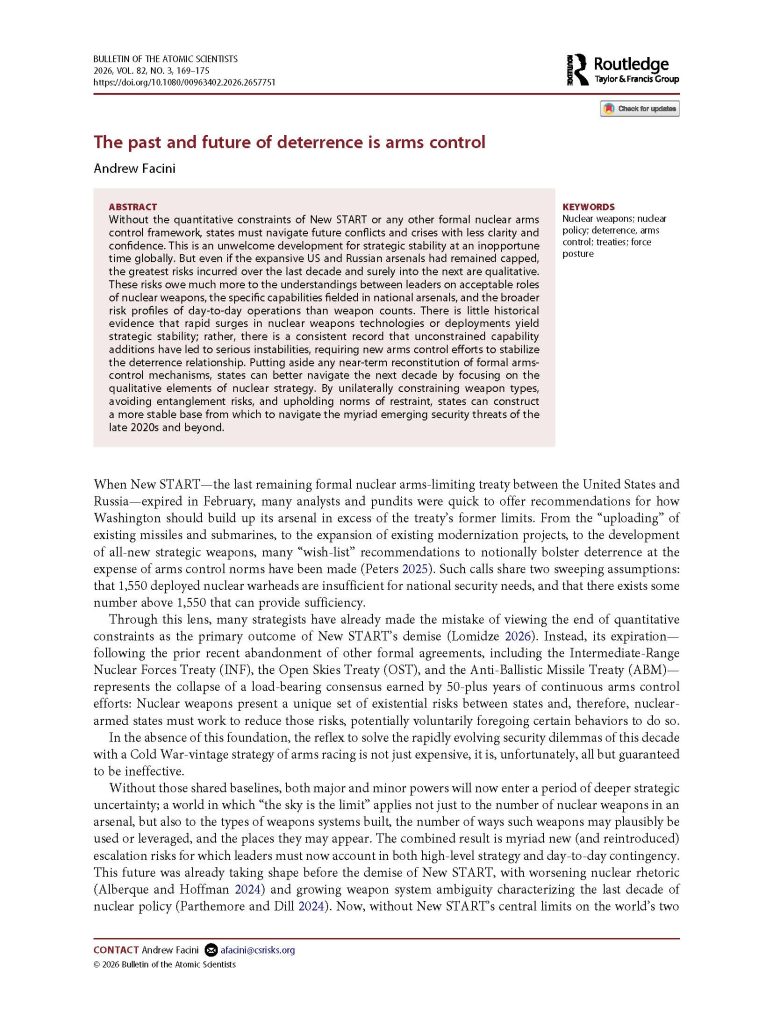
The Past and Future of Deterrence is Arms Control
Report: October 2025
The Council on Strategic Risks
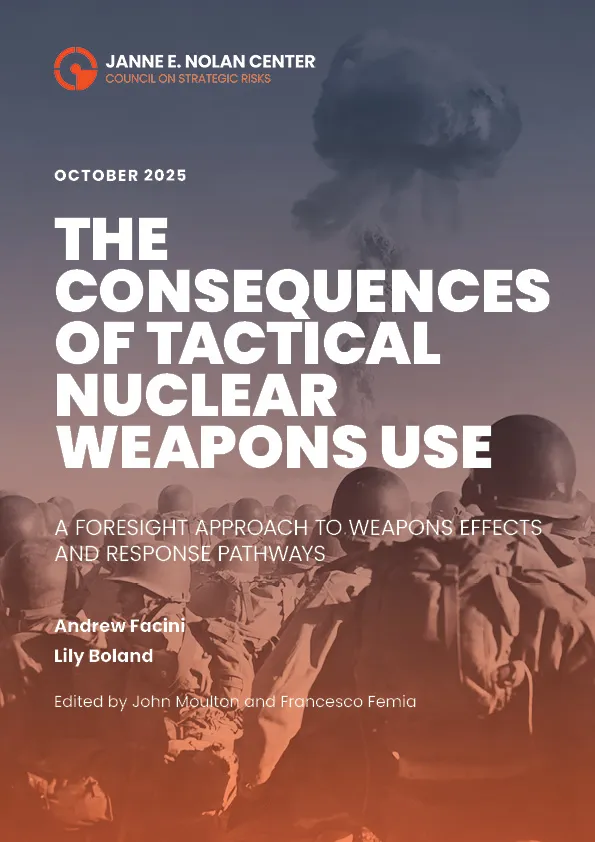
The Consequences of Tactical Nuclear Weapons Use
Project: 2024-Pres.
The Council on Strategic Risks
The Nuclear Weapon Systems Project
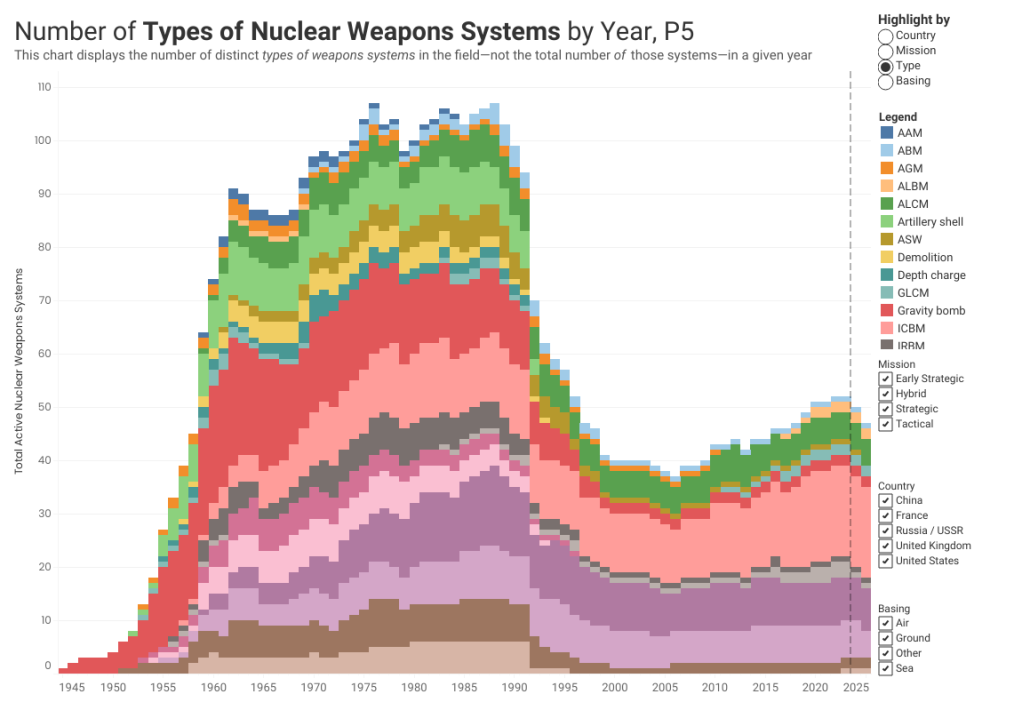
This project seeks to document and characterize every deployed nuclear weapons system that NPT-recognized nuclear states have developed in history. More than just a list of bombs, missiles, and artillery shells, the resulting dataset illustrates a complex story of risks, strategies, and lessons learned—and lost. We consider this data to be a living resource, and encourage outside contributions and feedback.
Chronological List
Featured Article
May 2026
Bulletin of the Atomic Scientists (Spring 2026)
The Past and Future of Deterrence is Arms Control
The degradation of quantitative-focused arms control with the loss of New START and other agreements is an unwelcome development for strategic stability at a time when international norms on the use of force are already disintegrating. But it is not too late to refocus national strategies and thinking to identify those measures that maximize stability.
December 11, 2025
War on the Rocks
We Might Regret Golden Dome’s Greatest Ambition
Though it may be tempting to dismiss exotic weapons like Burevestnik and Poseidon and their purported justifications as cynical political stunts, the most likely impact of Golden Dome is to incentivize America’s adversaries to double down on such destabilizing behavior by further developing long-range cruise missiles, hypersonic systems, undersea platforms, and even space-based offensive weapons systems. Taken together, these systems are much more concerning than any one type of weapon, and strategists should take steps now to avoid incentivizing a world with a greater reliance on them.
November 19, 2025
Bulletin of the Atomic Scientists
We’re Not Ready for Nuclear War on Social Media
Without active intervention, the mass media ecosystem is destined to fail when it will be needed the most.
October 28, 2025
Lawfare
Navigating Crises With a Lower Bar to Nuclear War
How can two countries slide from limited conventional skirmishes to nuclear signaling in a single afternoon? While the proximate answers lie in the long histories and dynamics between the two rivals, a critical accelerant is found in the presence of—and reliance on—so-called tactical nuclear weapons.
Featured Report
October 2025
The Council on Strategic Risks
The Consequences of Tactical Nuclear Weapons Use: A Foresight Approach to Weapons Effects and Response Pathways
If those worst outcomes of escalation are to be avoided, the political decisions made about responding to the first use of tactical nuclear weapons will be among the most important in history. Therefore, studying and understanding the full spectrum of nuclear weapon effects and identifying possible outcomes before any such use occurs will be indispensable and timely, given states’ increasing interest in developing new TNW and reliance on them as a means of articulating higher-level strategy. Any assumptions that they offer are a relatively safe, additional “layer” of deterrence or a predictable conflict management pathway should be thoroughly examined.
October 2025
The Council on Strategic Risks
Investing in the Future of Nuclear Deterrence
The S&T base must be viewed as a tool of deterrence and national strength in and of itself—and there are multiple ways that it should be bolstered and evolve.
January 14, 2025
The Council on Strategic Risks
Cutting the Nuclear Weapons Enterprise Serves No Strategy
Weakening the enterprise benefits neither a build-up or build-down approach and potentially ties the hands of negotiators.
October 2024
The Council on Strategic Risks
The Next Administration’s Nuclear Posture: A Principled Guide to Maintaining a Safe, Secure, and Effective Nuclear Deterrent
A set of principles that the next administration should follow to ensure deterrence and strategic stability needs are met responsibly, noting that the President of the United States has the full and ultimate authority to set US nuclear policy.
October 9, 2024
The Council on Strategic Risks
Seeking Out Moscow’s Early Nuclear Gravity Bombs
With these six new additions, we now count 145 types of nonstrategic nuclear systems deployed by the P5 from 1945 to today. Russia, previously an undercounted entry, now has 71 of these.
March 8, 2024
The Council on Strategic Risks
Strategic Stability’s Very Bad Week
When advocates want to return to a 2,500-warhead arsenal, or place nuclear weapons on conventionally armed submarines, the prior experiences of doing so—and learning to undo those decisions—must be a core part of the rationale.
December 4, 2023
Bulletin of the Atomic Scientists
New information tool on nuclear weapons seeks to identify the next arms control strategies
A key foundation for our project is the understanding that the types of nuclear weapons capabilities deployed at any given time matter greatly because they shape the risks of intentional, unauthorized, or accidental use of a nuclear weapon.
Featured Project
Launched November 2023
The Council on Strategic Risks
The Nuclear Weapons Systems Project: A Qualitative Approach to Nuclear Policy
This project seeks to document and characterize every deployed nuclear weapons system that NPT-recognized nuclear states have developed in history. More than just a list of bombs, missiles, and artillery shells, the resulting dataset illustrates a complex story of risks, strategies, and lessons learned—and lost. We consider this data to be a living resource, and encourage outside contributions and feedback.
October 27, 2023
Bulletin of the Atomic Scientists
Why the US fixation on increased nuclear capability won’t deter China but could lead to instability and nuclear war
A stabilizing nuclear deterrence strategy needs to counterintuitively accept the potential of not dominating at every level to keep a much worse war from breaking out.
August 2023
The Council on Strategic Risks
Ending Tactical Nuclear Weapons: A Brief History and a Path Forward
A report exploring the history of tactical nuclear weapons, highlighting their risks, prior arms control successes, and the risks proliferation poses today.
July 28, 2023
Bulletin of the Atomic Scientists
Oppenheimer’s vision for arms control is still upon us
In the end, his vision for arms control—and willingness to speak out for it—was incompatible with those drawing power from the bomb, and he was systematically and deliberately ruined for it.
March 28, 2023
The Council on Strategic Risks
Russian Nuclear Weapons and Belarus: NATO Should Continue to Stand Steady
An briefer responding to Moscow’s decision to forward-deploy tactical nuclear weapons in Belarus.
January 31, 2023
The Council on Strategic Risks
Blinken in Beijing: An Opportunity to Reduce Nuclear Risk
The good news is that there are many areas of potential common ground between the United States and China, and some early signs of momentum on which to build.
October 27, 2022
The Council on Strategic Risks
From Warfighting to a Fundamentally Limited Deterrent: Biden’s Nuclear Posture Review
Compared to the 2018 NPR, Biden’s document aims to blunt the arms-race momentum, maintaining some of the Trump-era modernizations while slowing or halting others. Most notably, it calls for the discontinuation of the new SLCM-N system and aims to resume the retirement plans for the B-83 megaton-class gravity bomb. The Adminsitration chose to sustain other modernization plans, including the GBSD replacement to the Minuteman III ICBM and the B-21 successor to the B-2 stealth bomber.
July 2022
Institute for Security and Technology
Atlas of Crisis Communications: Nuclear States
This atlas is part of IST’s work efforts to reinvigorate broader nuclear crisis control through research and development aimed at identifying and solving practical nuclear risk reduction gaps. This version is focused on the unique nature of hotlines between states with nuclear weapons. A later atlas will examine hotlines between states with nuclear weapons and those without, a dataset which has its own points of interest.
September 24, 2021
Newsweek
What Trump and Milley Tell Us About Nuclear Weapons
Compared to the 2018 NPR, Biden’s document aims to blunt the arms-race momentum, maintaining some of the Trump-era modernizations while slowing or halting others. Most notably, it calls for the discontinuation of the new SLCM-N system and aims to resume the retirement plans for the B-83 megaton-class gravity bomb. The Adminsitration chose to sustain other modernization plans, including the GBSD replacement to the Minuteman III ICBM and the B-21 successor to the B-2 stealth bomber.
October 2, 2020
Responsible Statescraft
A US nuclear weapons surge in 2021 would have no strategic value
An op-ed addressing the rumors that the Trump administration is considering up-loading the amount of nuclear weapons after allowing New START to lapse in February 2021.
August 6, 2020
The Hill
Hiroshima 75 years later: The fallout continues
This year’s milestone anniversary is an excellent opportunity to seek out and uplift the voices of those most affected by these weapons, demonstrate new ways for people to recognize their proximity to them, and create effective new coalitions for political change.
January 28, 2020
Bulletin of the Atomic Scientists
The low-yield nuclear warhead: A dangerous weapon based on bad strategic thinking
The regrettable reality is that, when it comes to nuclear weapons, clear strategy has always followed capability. The Cold War offers many examples in which a hasty deployment or a misinterpreted exercise resulted in miscalculation and crisis. In recent years, the US government’s handling of nuclear strategy has begun to resemble the most dangerous years of the 1950s, where new technologies were fielded faster than plans and guidance could be properly articulated.
December 1, 2018
Bulletin of the Atomic Scientists
A Grim Vision of Nuclear War
A review of The 2020 Commission Report on the North Korean Nuclear Attacks Against the United States, a speculative novel by Jeffrey Lewis.
October 2, 2018
BBC World Service Newsday
On the “Presidential Alert”
A discussion with Newsday‘s Alan Kasujja on the looming national EAS test. Segment begins at 16:35.
October 2, 2018
The Boston Globe
All Americans should welcome alerts from President Trump
As far back as the 1960s, the president’s ability to alert the nation was seen as a crucial part of confronting the only national emergency that mattered: nuclear war.
May 2018
Master’s Thesis
Harvard Extension School
Restraint by Design: The Ideological Origins of ‘Minimum Deterrence’ in China’s Nuclear Weapons Program
On October 16, 1964, with an ominous mushroom cloud rising over its northwestern frontier, the People’s Republic of China entered the exclusive group of nuclear weapons states, then a four-member club. Leaders in Beijing embarked on the path of nuclear weapons development reluctantly, they claimed, in response to continued atomic “brandishing” from the United States that had steadily abraded their nation’s security in times of conflict. Indeed, it was not until the late 1950s, after experiencing repeated threats of nuclear attack, both coded and explicit, that Chinese leader Mao Zedong determined that the atom bomb was truly a necessary component of their national security strategy.